Paths are often brought into the therapy room. There is so much symbolism associated with paths. We are walking a path each day of our lives, a metaphorical path, as well as practical paths. Our metaphorical path is unique to each one of us, no-one can walk it for us, only alongside us, and exploration of our paths can lead us to better understanding of our selves, and where we are heading.
Paths exist because people have walked a route many times before, making a path easier for us to find and walk ourselves. When I’m walking on the Chase, I often follow the less travelled path than the obvious one that has been laid down ‘officially’ for people to walk. As I walk I pay attention to what the path feels like underfoot, is it bumpy? or smooth, or slippy? does it have bends, twists, or is it straight? can two people walk along side by side, or is for one person? Are there puddles or blocks? Where does the path lead to? is it a dead end? or is there something just hidden from view, if we just have faith that staying on the path will take us to where we need to go.

Photograph by Rebecca Gallop
Paths of Decision – Paths of Direction
There is something predictable about staying on the straight and narrow path, one that is familiar, it can bring a sense of safety. People often talk about taking or choosing the right or wrong path. The straight and narrow being the correct path and the wide and winding being the wrong path that will ultimately lead to some sort of destruction. As children our paths are set out for us socially, economically and environmentally, by external factors that we are encouraged to conform to. Then as we start to grow and make our own choices, trusting more in our own internal compass alongside a map to guide us, our paths move and change. We start to take risks, we focus on our choices, what paths to take, what paths to avoid, what direction we want to take in life. Just because you may walk a different path to others, it doesn’t mean you are lost. There is no right or wrong, each path is unique, just as we are unique. Some people find it very reassuring to walk a very fixed path, and others prefer something less structured.
Personal Experience ~ Once, when climbing in the Lake District, I climbed a small hill, following Wainwright’s directions along a path to reach the summit. The route took me up steep ridges, through woods, boggy areas, fields with cattle, I thought I would never find the top. When I eventually got to the top, exhausted and admiring the view, I noticed that other people were coming up the hill from a different path. We all reached the top, however, their climb was significantly easier, and quicker. At the time, I wished I had known the alternative route, but on reflection, that hill taught me so much about myself!
Often when out walking, I come across a fork in the path, and I am left wondering what if I go left, or right? what if I make a mistake? without a map of the landscape, or knowing what is ahead, this is a decision that can difficult to answer. I am of course, talking about an IOS map, but even these great navigation tools can let us down, or hinder us, they don’t show us the way metaphorically, for that we need our own tool, our internal compass.

Acrylic on Canvas
by Rebecca Gallop
The painting above ‘Guardians of the Woods’ was painted during a time of transition for me. I was at a cross roads, to an unknown destination. I had choices, that in itself was a scary experience having spent most of my life conforming to the views and direction of others. When those external factors are no longer there, it is about looking within for the answers. I also found that the tree’s felt like people watching me as I walked along the path, not in a negative way, but a protective, guiding way. The message I am sharing is always left for the viewer to interpret. Either way, all paths join to make another path.
I often wonder what would happen if I wander off the path? would I get lost? This is when I really need to connect with my internal ‘compass‘. Some would call this: moral compass, internal self, inner self, intuition, inner guide. Our internal compass or internal self is there to direct and guide us. We often forget it is there, ignore it’s call, choose to listen to external forces rather than our internal self, it becomes a bit rusty, a bit neglected and powerless. Our internal compass gets put on a shelf, and we trust in external forces directing our path, rather than choosing our own path. When we do this, we can end up feeling very lost, not knowing which way to go, or what we will find. Often this leads us to walking a path that we wouldn’t have chosen had we had our internal compass able to guide us. Feelings of depression and anxiety can be felt when we are so removed from our internal compass, or internal self, and so focused on pleasing others that we loose our sense of who we are in the process.
When we trust in and care for our internal self, our internal compass, we are able to wandering off the designated path, into the more alternative terrains. When I’m walking on Cannock Chase, I often wander off the path. Deer walk a different path in the woods, their paths are visible for those who look. They have a route they walk day in day out, leaving a trail, a path for others to follow, if they choose. I have found, through experience, that wandering off the path can be risky, adders, brambles, gorse, holes, all prove to be a challenge (bit like life!). Its about taking risks, after all, there is danger all around, its how we choose to perceive it that can be so insightful. It can also be a point of illumination, finding the hidden, the unknown. It may that there are paths hidden from first view, when we explore, we are opening ourselves up to new ideas, experiences. For me, the experience of stepping off the path helps me to find my path. When I trust in my internal self to keep me safe, I feel safe enough to explore the hidden paths.

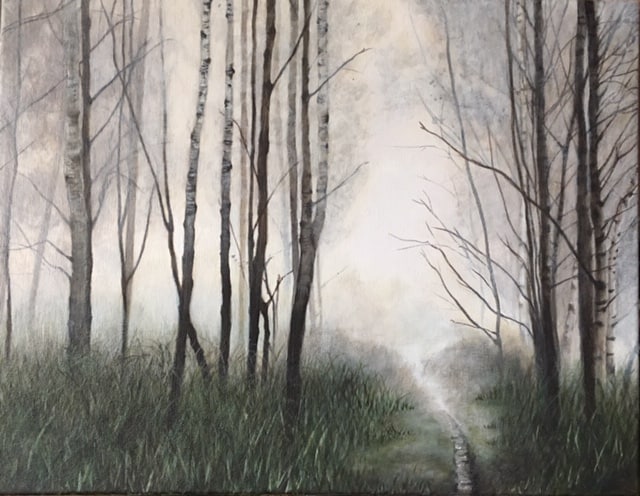
Acrylic on Canvas
By Rebecca Gallop
This painting ‘Beithe’ is full of symbolism and metaphor. It is based on an area that I walk regularly on Cannock Chase. This particular time, the view was tricky due to the heavy early morning Winter mist making visibility challenging. I found myself on an unfamiliar path. However, what I found was that the path became clear in front of me as I braved one step at a time. I didn’t know where it would lead. I trusted in the process of walking the path. Parallel to this experience, was a point in my life where I had been questioning my path, where I was heading. At the time I felt like I needed a path that was clear, where I could see the end point. What this experience showed me was that even though the end point may not be in sight, the path may become clear, but not in the way I expect and its about trusting in my internal compass to help guide me along the way. What is also intriguing about this painting, is the type of tree is Birch, which is symbolic of new beginnings in the celtic and ogham calendars, hence the name ‘Beithe’ which is ogham for Birch.
Spiritual Paths There are many spiritual paths, and this is an important part of the journey, living our lives.
Everyone is on a spiritual path – most people just don’t know it”
Marianne Williamson
We can all find life to be difficult at times, no one said it would be easy, or that there wouldn’t be any blocks in the path. The element of spirituality can bring clarity to life journeys, and show the paths that you may need to take. Being spiritual does not mean religious, however you can be spiritual and religious. Spiritual paths include being honest, with yourself and others, being able to live your life in a way that is genuine, being free to love yourself, and others and following a path of your choosing that provides you with guidance and fulfilment. It can also mean following a specific spiritual or religious path, that gives you direction, a designated purpose, structure and guidance, possibly through religious text, ritual or symbolism.
Therapy paths As a therapist I am there to walk alongside you on your path, to help you explore and identify your path, to keep you in a safe space while you wander about, in your internal landscape, exploring hidden paths. If your path has had many twists and turns, leading you to not really know or trust in paths I am here to help support you. Its about looking to see if the path you are on is the right one for you, and where you are heading. I am also there to help you find your internal compass or internal self, give it a bit of care and attention, to get back on your chosen path.
New paths equal new beginnings, when we change direction, and take a different path, it can be exciting, the anticipation of walking a new path, where it will lead. Okay, I know it is not always comfortable, or easy, in fact it can be scary, anxiety provoking. To keep moving forward, sometimes it is about leaving the old path behind, getting the map out, tuning in the internal compass and braving a new path one step at at time.