
Jelly fish are one of those creatures that we rarely see in day to day life. You will be surprised to hear they have been around 600 million years, before dinosaurs, tree’s, fungi, and have survived five mass extinctions. They definitely know a thing or two about survival!

Stranded
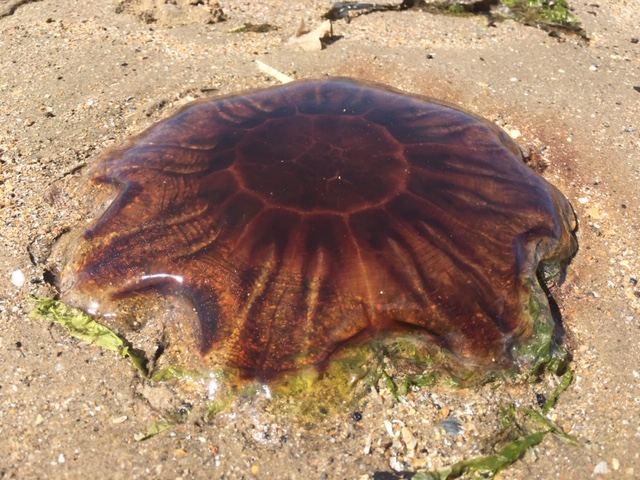
Sometimes jellyfish get washed up on the beach due to the tide, where they become stranded in the sand. Knowledge reminds me not to touch them, that they are capable of inflicting harm, dangerous (we all know jellyfish can sting) if we come into contact with them. Yet when observing them they seem so easily wounded.

I wonder if they notice that they are stranded, do they feel alone? Do they need help to get back into the water? will they survive if they are stranded in an environment that is not healthy for them? I can’t say I have ever put a jellyfish back into the water, although the urge to rescue them is strong! Sometimes we can depend on others to help rescue us when we are stranded. Sometimes, jellyfish take the opportunity to be taken back into the sea when the tide comes back in. Sometimes, like jellyfish, we hurt the ones that are trying to help us. Sometimes our sting is our only protection from predators, there to help us survive and keep us safe from harm.

Photograph by Rebecca Gallop
There is something so intriguing about stranded jellyfish. We can get to observe them really closely when they are outside of their natural environment. They are so fragile, graceful and delicate in their appearance. I wonder whether they notice how beautiful they truly are?

Feeling Stuck
One particular time while beach combing, I spotted a jellyfish in a rock pool. As the tide brought in the waves, flowing into the rock pool, the jellyfish moved with the water. I could see it potentially returning to the sea with the aid of the motion of the water. As each wave came and went, the jellyfish got closer and closer to leaving the rock pool. I was there a while, and it remained in the pool, bobbing about. Soon enough the tide would be out, and the tidal water would no longer enter the rock pool. I considered the consequences of this, and had concern for the jellyfish, wanting to rescue it and help it back into the sea. When we, as humans feel trapped, we look for the current or movement to get us over the ‘feeling of being stuck’ , to escape the rock pool into the sea. Of course, it is easy to assume that by escaping, all will be well. However, it could work the other way, we might feel comfortable with where we are, and not want to change. Yet the tide moves us about, forcing us to change direction or environment. Nothing ever stays the same, life moves forward, regardless of whether we want it to or not.

Photography by Rebecca Gallop
Jellyfish can show us that there are always things in life that we can’t control, but we can control how we react to them. They show us to trust and let go, go with the flow. Of course, we might not always like where we are, or where we are heading, but one thing we can take with us is our sense of identity. Jellyfish show us how to adapt to life as it is, to survive with the innate talents and abilities we have.
Moving with the currents

All of the jellyfish I have spotted in the sea seem to drift past each other. They float rather than swim through challenging times, and rely on movement for sustenance in their lives. Do you feel like you are sometimes drifting aimlessly, or purposefully? or are you flowing with life, balanced and heading towards your goals by navigating currents to fulfil your purpose?
The importance of emotions
Apparently, jellyfish are sensitive to emotions, and when they are stressed, they grow younger, moving backwards through their life cycle, to a less mature state. Just think, if we could, as humans, refuse to move forward in adulthood and choose to become young children again. We can ask the question ‘what am I here for?‘ or ‘why am I going through all these experiences?‘ There is something about the jellyfish that is a reminder of checking in with our emotions, are we able to rein them in? or react appropriately to all the emotional challenges of our lives? Unchecked emotions ultimately define us. When we react appropriately to emotional challenges in our lives, then we can define our place in the world and our lives.
Letting go

When we imagine the movement of a jellyfish, the way they swim is like how we take a breath, this is how they move, they are pulled through the sea. Their pulsations are timed and controlled by a neurological node (called a pacemaker) that is similar to our own node that controls the beat of our heart. We can use the visualisation of the jellyfish in the depths of the deep sea, pushing its way to the surface. Then, if we choose to, we can begin to let go of pieces of our own trauma into the sea. I imagine this like an analogy of letting go of things that keep us in the deep dark depths of the bottom of the sea, holding us down, forcing us to feel weighted down daily. Imagine pushing towards the light of the surface of the sea, releasing what is holding us down. When we think of water, we can also think of cleansing, washing away, making a lighter, brighter you.